
Guitar Books


Guitar Books

Teach yourself guitar. 

I’ve been writing instructional guitar books since the mid-’90s and have always loved sharing fresh ideas and creative approaches to playing and teaching guitar. While I’ve written several titles over the years, my primary recommendation for anyone wanting to build strong technique and musicality is my Guitar Antics eBook. It’s a comprehensive and practical guide that expands on my earlier *Functional Guitar* methods and explores harmonic minor and diminished patterns, inventive arpeggios, phrasing concepts, and expressive licks. It’s designed to help players at all levels uncover new sounds, refine their touch, and strengthen their command of the instrument.  

For guitarists looking for something a little different—and a lot of fun—I also offer two creative side projects: Crazy Clarinet Lines for Electric Guitarists and Classic Violin for Guitar. These books feature technical transcriptions of clarinet and violin pieces, reimagined for guitar, offering fresh ways to challenge your technique and spark musical inspiration.  
 
If you’re serious about growing as a guitarist, start with Guitar Antics. It’s my go-to course for helping players break through plateaus and discover new dimensions of expression and control on the instrument.


Eric Peterson - Fiery Flute Lines

Eric’s latest eBook transcribes some fiery flute lines for the electric guitar. This has been an ongoing project for the last few years. Hopefully, will be completed this year.


Crazy Clarinet Lines for Electric Guitarists

Your electric guitar phrasing can be improved by practicing licks and melodic lines composed on other instruments, try these, technical clarinet lines for the guitar. Available from: Amazon Kindle | Google Play Books | Apple Books | Kobo


Classic Violin for Guitar Book

Cool violin excerpts arranged for electric guitar, including works by Bach, Vivaldi, and Paganini. Available from: Amazon Kindle | Google Play Books | Kobo | Apple Books


Guitar Antics

Replace that outdated method book with this functional guitar approach, chock-full of examples and applications of music theory, exercises, and cool licks. Available from: Amazon Kindle | Google Play Books | Kobo | Apple Books
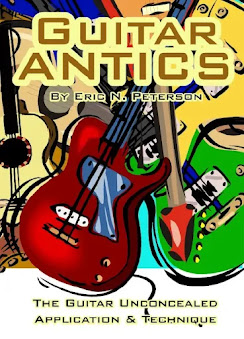


(Old) Guitar Antics Book - The Guitar Unconcealed | Application & Technique

No longer available, widely utilized with Eric’s guitar students from 2000-2016. Recommend the updated eBook above, 'Guitar Antics.'


Functional Guitar

This was used extensively during the height of Eric's teaching days from 2000-2016. It's no longer available, and the concepts were further refined and made available in the Guitar Antics book.


Eric Peterson - Ready, Set, Guitar

Used as a Seniors Guitar Method for some local Senior Centers. No longer available.

Popular posts from this blog

Beginner's Guide · Guitar Selection

  What's the Best Guitar for a Beginner? After 30 years of teaching guitar and years managing a Guitar Center store, I've answered this question hundreds of times. Here's the honest answer — and the specific guitars I'd hand a new student today. There is no single "best" beginner guitar. What there is, however, is the best guitar for  you  — and it's determined by a handful of factors that most first-time buyers overlook entirely.  Budget matters, of course, but so do the style of music you want to play, the physical feel in your hands, and frankly, whether you think the guitar is cool enough to actually pick up every day. Before we dive into specific recommendations, let's talk about what actually matters. Pro tip from the shop floor: When I managed Guitar Center, the number-one reason beginners quit wasn't difficulty — it was buying a guitar that sat in the corner because they didn't love it. Buy something that makes you want to play it ever...

Musical Burnout and Rediscovering Your Passion: It’s Okay to Feel This Way

  For many lifelong musicians, music has been more than a pastime—it’s an identity formed over countless hours teaching, recording, performing, and creating. Yet even with a house full of instruments, a studio ready for use, and shelves of sheet music, it’s normal to experience phases where the urge to play fades or disappears altogether. If you find yourself playing less often but still call yourself a musician, you’re not alone—and there’s nothing wrong with how you feel. Recognizing Musical Burnout Burnout is real, and it often sneaks up on people who have spent years steeped in their craft. What once sparked immense joy can start feeling like an obligation. You might notice physical or emotional exhaustion, a lack of motivation to pick up your instrument, or guilt over “not playing enough.” Even then, your passion for music never truly vanishes—it simply takes on a new form. Why It’s Okay to Step Back Periods of “musical rest” are vital for creative replenishment. Just as athle...

How to Keep Creativity Flowing When Producing Your Own Music

If you make music alone in a home studio (or mostly by yourself), you already know the feeling: one day you’re on a roll, the next day you stare at the same DAW screen and nothing happens. Creativity isn’t a faucet you can turn on and off at will — but it’s also not pure luck. With a few simple habits, constraints, and friendly rituals, you can make creative momentum more reliable. Below are practical ideas—part mindset, part workflow—that I use and recommend to students and colleagues. Try a handful, tweak them, and keep the ones that actually help you make more music. 1) Give creativity a schedule (but keep it playful) Treat creative sessions like appointments. Block 60–90 minute windows in your calendar and protect them. The pressure of a short, focused session often sparks choices and momentum you won’t get from an open-ended “I’ll work later” plan. That said, make at least one session per week a “no-expectations” jam—no goal, just exploration. Scheduled practice helps you ge...